


Mobility, Flexibility & Stability Screening
Anna is in the “neutral mover” category. Her thoracic mobility was neutral at 60 degrees of rotation to the right and left. She lacks pelvic control in his pelvic tilt isolation which will prevent energy transfer into the upper body. She was good in the pelvic rotation test, which indicates that she will have ability to disassociate his upper and lower body very efficiently. Torso disassociation was good as well. This means she will have the ability to create energy transfer through torque.
Anna passed the overhead squat test which shows good overall body mobility. She has good core stability which will affect energy transfer speed up the chain.
She has an under-developed scapular region, which will reduce torque through her upper body anchor. Her scapular retraction was in the “loose” category. Shoulder flexion was very tight, yet external shoulder rotation was good. Internal shoulder rotation was good on both arms.
Hip rotational mobility was “neutral.” She was able to turn 55 degrees in the right and left hip internally. Externally, she was 60 degrees on the right and the left.
Her lower body showed poor left and right leg stability, and her glutes stabilized very well during the glute bridge test. Side bend was adequate in both directions.
All wrist and cervical screens were a pass.
Force Plate Swings
Below is video of the swing analysis. I will walk you through this matched up with video.
Anna has the start of good metrics that we should be able to clean up and improve. She loads into her toes rather than the heel and pushes hard into the ground with her toes in the loading mechanism. That forces her to release energy early in the load and she goes from 105% BW to 80% BW quickly. We want to hold above 90% into the forward advance. Back leg torque numbers are low at 3 Nm due to overloading her back leg outside of her back shoe. 45 Nm is what we are shooting for. Her front leg post is average and the rate of force development is quick and good. Front leg vertical force is under the 200% BW we are looking for at 155%. Her horizontal force is decent at 50% BW with a good rate of force development – 70% is considered good. Her X-axis timing number (one of the most important we get from the force plate) is under 10%. 80% is what I consider proficient. This means she’s leaking into her front leg prior to making the turn, vs. holding anchor with her back shoe into the ground and turning into her landing. This will limit adjustability. Her lower body metrics will clean up with the feeling of keeping pressure inside her knees/feet and keeping her hips connected instead of moving pressure to the outside of her feet/legs.
KVEST Sequencing & Rotational Speeds
The 3d readings are on kinematic sequencing and rotational speeds.
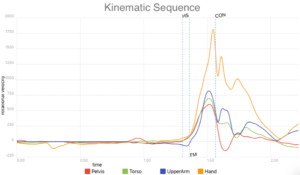
Anna is close to having the preferred swing sequence. She gets some early length in her swing from not fully loading her scap. This will allow her to turn her body to turn the bat versus her early disconnection with her hands. Otherwise, body energy transfer is off to a good start. Pelvis speed is lower than ideal due to the under-utilized front leg. Her pelvis speed is in the “needs improvement” category on our real speed graph at 600 deg./sec. Torso speeds are in the “needs improvement” category on our real speed graph at 700 deg./sec. The arms get little gain at 800 deg./sec and overall hand speed is average at 1800 deg./sec. Torque is very limited which limits the overall stretch in the body, which goes back to the lack of scapular load.
Bat Sensor Data
Bat speeds are slightly below average at 56 mph. Attack angles and side bend are appropriate for the pitch height as she attacks from underneath the ball. Rotational acceleration is average at 11 G’s. Time to impact is good at 160 ms. Rotational acceleration and bat speed will be improved with added torque.
Summary & Recommendations
- Load into the heel vs. toes.
- Keep pressure inside her feet versus getting her hips disconnected in a “bow-legged” position.
- Maintain back leg connection to the ground in advance and into the turn.
- Get a more forceful heel interaction with the ground to speed up pelvis numbers.
- Drill focuses on creating torque. This comes from getting a bigger scap load and maintaining it longer.
 PRIVATE LESSONS
 CLASSES
 CAMPS
CAMPS ELITE TEAMS
 ELITE BASEBALL TV
 VIDEO ANALYSIS
 BIOTECH CAGE
 SHOWCASE